Hornet Control & Nest Removal
Don't let aggressive hornets threaten your family. Inspect Pest Control provides safe, effective hornet removal and nest treatment services. Protect your property today!
Hornet Removal in NJ — Bald-Faced & European Hornets
What "Hornet" Actually Means in NJ — And Why It Matters
"Hornet" is one of the most misused pest terms in the country. Most calls labeled "hornets" turn out to be yellowjackets, and most football-shaped paper nests are bald-faced hornets — which are technically a yellowjacket species, not a true hornet. Getting the ID right matters because the treatment, the timing, and the risk level all shift depending on what you're actually looking at.
This page covers the two species New Jersey homeowners genuinely need to think about when they say "hornet":
- Bald-faced hornet (Dolichovespula maculata)
- European hornet (Vespa crabro)
If you're dealing with yellowjackets, paper wasps, or mud daubers, those are covered on our wasp control page. The protocols are different and that page goes deeper on those species.
Bald-Faced Hornet (Dolichovespula maculata)
What they look like. Black body with bright white markings on the face, thorax, and abdomen. Large — about three-quarters of an inch. Distinctive enough that ID is rarely a question once you see one up close.
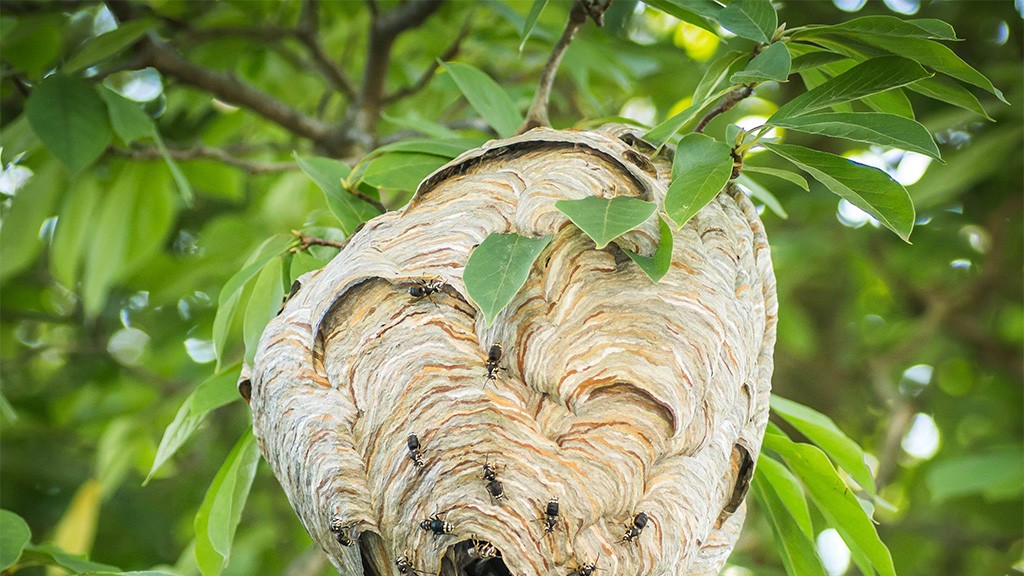
Where they nest. Aerial nests only. The classic football-shaped or teardrop-shaped gray paper nest hanging from a tree branch, under an eave, on a shrub, or off a porch overhang. Colonies start small in spring and can grow to 2-3 feet tall by late summer with several hundred workers inside.
Behavior. Aggressive in defense of the nest, generally not aggressive away from it. They'll forage in your yard without bothering you, but anyone who walks within a few feet of an active nest is going to get a response. Multiple stings are routine because they don't lose their stinger after one hit.
Lifecycle. Annual colony. The whole nest dies after the first hard frost in the fall. Mated queens overwinter in protected spots (woodpiles, leaf litter, under bark) and start fresh nests elsewhere the following spring. Bald-faced hornets do not reuse old nests. A nest discovered in October is on borrowed time and often best left alone if it's in a remote location.
European Hornet (Vespa crabro)
What they look like. Brown and yellow. Very large — over an inch, the largest stinging insect routinely seen in NJ. Often misidentified as Asian giant hornets by homeowners who've never seen a European hornet before. The two species look nothing alike to anyone who knows what they're looking at, but the size alone is enough to set off alarm bells.
Where they nest. Cavity nesters — tree hollows, wall voids, attics, soffits, sheds, and outbuildings. Unlike bald-faced hornets, you almost never see the nest itself; you see the hornets coming and going from a single entry point. Colonies of several hundred workers by late summer.
Behavior. Not generally aggressive in flight, but extremely defensive of the nest. The bigger issue is what makes them unique among NJ stinging insects: European hornets are active at night. They're attracted to porch lights, security lights, and lit windows, and they're the only stinging insect in the state that flies and forages after dark. They'll also strip bark from ornamental trees (lilacs, dogwoods, rhododendrons) to feed on sap and to use the fiber for nest construction — distinctive damage that can confirm an ID even if you haven't seen the hornets.
Lifecycle. Same annual cycle as bald-faced hornets — colony dies in fall, queens overwinter elsewhere, no nest reuse. But European hornet queens often select the same kind of cavity year after year, which means the structural condition that allowed access this year will likely produce another colony next year if it's not addressed.
How Treatment Differs Between the Two
These species both fall under "hornets" colloquially, but they call for different approaches.
Bald-Faced Hornet (Aerial Nest Treatment)
The nest is visible, which is both a help and a hazard. Treatment is a quick-knockdown contact insecticide applied directly to the nest entrance, followed by physical removal of the nest once activity has fully stopped. The key variables:
- Timing. Treatment happens at dawn, dusk, or after dark when workers are inside the nest. Midday treatment is dangerous because half the colony is foraging and returning workers will swarm the area around the nest.
- Single application is usually sufficient for accessible aerial nests, but late-summer nests with several hundred workers may need a second application 24 hours later to handle stragglers.
- Ladder work is the biggest risk. This is the most common DIY injury scenario in this category — homeowner with an aerosol can on a 12-foot ladder, gets stung, falls. The injury from the fall is almost always worse than the stings.
European Hornet (Cavity Nest Treatment)
This is the harder job. The nest is inside a void you can't see, and treatment has to reach the colony through whatever entry point they're using. The protocol:
- Dust formulation, not liquid. Liquid pools at the entrance, kills the workers it contacts, and leaves the rest of the colony to seal off and reroute through interior wall cavities — which is how homeowners end up with hornets coming out of light switches, recessed lights, and electrical outlets. We use deltamethrin or cyfluthrin dust applied with proper injection equipment.
- The entry point stays open for several days after treatment. The remaining hornets need a way to exit the structure to die outside the wall rather than inside it. Sealing too early is a serious mistake — the colony pushes for a new exit, often through your interior drywall.
- Final sealing happens after activity has fully stopped — usually 5-7 days post-treatment. Then we identify and address the structural condition that allowed entry, because European hornet queens tend to revisit the same kind of cavity in subsequent years.
When DIY Is and Isn't Reasonable
Honest answer: a small, accessible bald-faced hornet nest discovered early in the season can be handled by a homeowner with the right product, the right protective gear, and the right timing. We'd rather tell you that than scare you into a service call you don't need.
DIY is reasonable for:
- A small (basketball-sized or smaller), clearly accessible bald-faced hornet nest on an exposed surface, treated at dusk with proper equipment.
- A discovered nest in October when frost is imminent and the nest is in a remote location — leave it alone, it's dying anyway.
DIY is not reasonable for:
- Any European hornet situation. The nest is inside a structure, treatment requires injection equipment and dust formulation, and the species is large enough that stings are particularly painful.
- Late-summer bald-faced hornet nests with hundreds of workers. A single hardware-store can isn't enough product, and partial knockdown produces a defensive, agitated colony on day two.
- Any nest in a wall void, soffit, attic, or other cavity regardless of species.
- Any situation where someone in the household has a sting allergy.
- Any nest within 10 feet of a high-traffic area (deck, walkway, doorway, kids' play area, garden bed).
Sting reactions are also cumulative for some people — repeat exposures build sensitization, so someone who's been stung before without issue can still go into anaphylaxis on the next one. This is the variable people most often underestimate.
Inspect Pest Control's Hornet Treatment Protocol
Every job starts with species ID and nest location. Both inform which product, which application method, and what time of day the work happens.
Species ID is done from a photograph or in-person observation before treatment. Send us a photo when you call — it lets us bring the right products on the first visit and gives us a head start on the inspection.
Bald-faced hornet treatment uses contact insecticide injected at the nest entrance at dusk or after dark, with physical nest removal once activity has fully stopped. Late-summer nests may receive a follow-up application 24 hours later.
European hornet treatment uses deltamethrin or cyfluthrin dust injected through the entry point with proper application equipment. The entry stays open for several days while the colony dies out, then gets sealed once activity has fully stopped. We then assess and address the structural condition that allowed entry, because European hornet queens often revisit the same kind of cavity in subsequent years.
100% satisfaction guarantee. If the colony isn't eliminated, we come back and retreat at no additional cost until it is.
Get Started
Call 973-309-7333 or visit inspectpest.com for a property assessment and a free quote. Send a photo of the nest or the hornets if you have one — species ID and treatment planning both go faster with a clear visual.
Dealing with yellowjackets, paper wasps, or mud daubers instead? Those are covered on our wasp control page.
Get Your Hornet Removal Quote – Protect Your Home Now!
Are aggressive hornets making your Cedar Grove home or yard feel unsafe? Don't let these stinging pests take over your outdoor spaces. At Inspect Pest Control, we specialize in safe and effective hornet removal for homeowners across New Jersey. Simply fill out the form below with your details, and one of our friendly experts will call you back promptly with a personalized, no-obligation quote. Get the swift and reliable service you need to protect your family and reclaim your yard today!
Behind the success stories
Read why customers choose us!

100% Satisfaction Guaranteed
We stand firmly behind the quality of our work with a 100% satisfaction guarantee. If you're not completely satisfied with our pest control service, we'll return to re-treat your home or business at no extra cost. If we still can’t resolve the issue to your satisfaction, we offer a full refund guarantee to ensure your peace of mind.

Family Owned and Operated
As a family-owned and operated business, we take great pride in our craftsmanship. We recognize the vital role of a clean and healthy home or business, and we're fully committed to providing top-notch pest management services.

4
reviews
170
reviews
55
reviews
8
reviewsGot an emergency?
Frequently Asked Questions
Frequently Asked Questions about our services
Wasps are a type of stinging insect. Some species live in colonies, while others are solitary. They have pinched waists, six legs that hang down in flight, and little to no body hair. In nature, they are predators that help control nuisance insect populations and aid in pollination.
Yes, most wasp species are dangerous as they can deliver painful, venom-filled stings to defend themselves and their nests. German yellow jackets are particularly aggressive. Wasp venom can cause severe allergic reactions in both people and animals, which can be life-threatening.
Wasps may choose your property for nesting due to the availability of safe shelter in yards, homes, other structures, trees, and woodpiles. They are also attracted to gardens, outdoor eating areas, compost piles, and garbage for foraging food for themselves and their larvae.
Professional pest control is one of the most effective ways to get rid of wasps from your property. Inspect Pest Control offers comprehensive, eco-friendly solutions to solve current wasp problems and prevent them from returning, providing guaranteed services with transparent pricing.
Other services
Some other service you might be interested in