NJ Rat Control | Expert Rodent Removal Services
Protect your property from destructive rats with Inspect Pest Control's expert rodent removal services. We offer safe, and effective solutions to eliminate rats and prevent their return.
NJ Rat Control & Removal | Inspect Pest Control
A rat is not a bigger mouse. It is a smarter, stronger, more destructive animal that is harder to trap, harder to exclude, and far more capable of damaging your home. By the time most North & Central Jersey homeowners see a rat, the population is already established. At Inspect Pest Control, we remove rats and seal the structural gaps they used to get in, so the problem ends instead of repeating.
We serve homes throughout Essex, Morris, Passaic, Union, and Bergen Counties, including Montclair, Cedar Grove, Verona, West Orange, Belleville, Nutley, Bloomfield, Parsippany, and surrounding communities.
Why Rats Are a Serious Problem, Not Just a Nuisance
Rats cause damage on a scale mice do not. A rat's incisors never stop growing, so it gnaws constantly to wear them down, including through electrical wiring, water lines, drywall, and even soft concrete and lead pipe. Rodent-gnawed wiring is a recognized cause of house fires. A single pair of Norway rats can, in theory, produce hundreds of descendants in a year, so a small problem becomes a structural one quickly.
They are also a genuine health concern. Rats can spread pathogens through their urine and droppings, contaminate far more food than they actually eat, and carry secondary pests like fleas and mites into the home. Their droppings and shed hair degrade indoor air quality, which matters most in homes with children, older adults, or anyone with respiratory conditions.
The Rat You are Dealing With in New Jersey: The Norway Rat
Nearly every rat infestation in New Jersey is the Norway rat, so identifying yours is rarely in question, but understanding how it behaves is what makes treatment work.
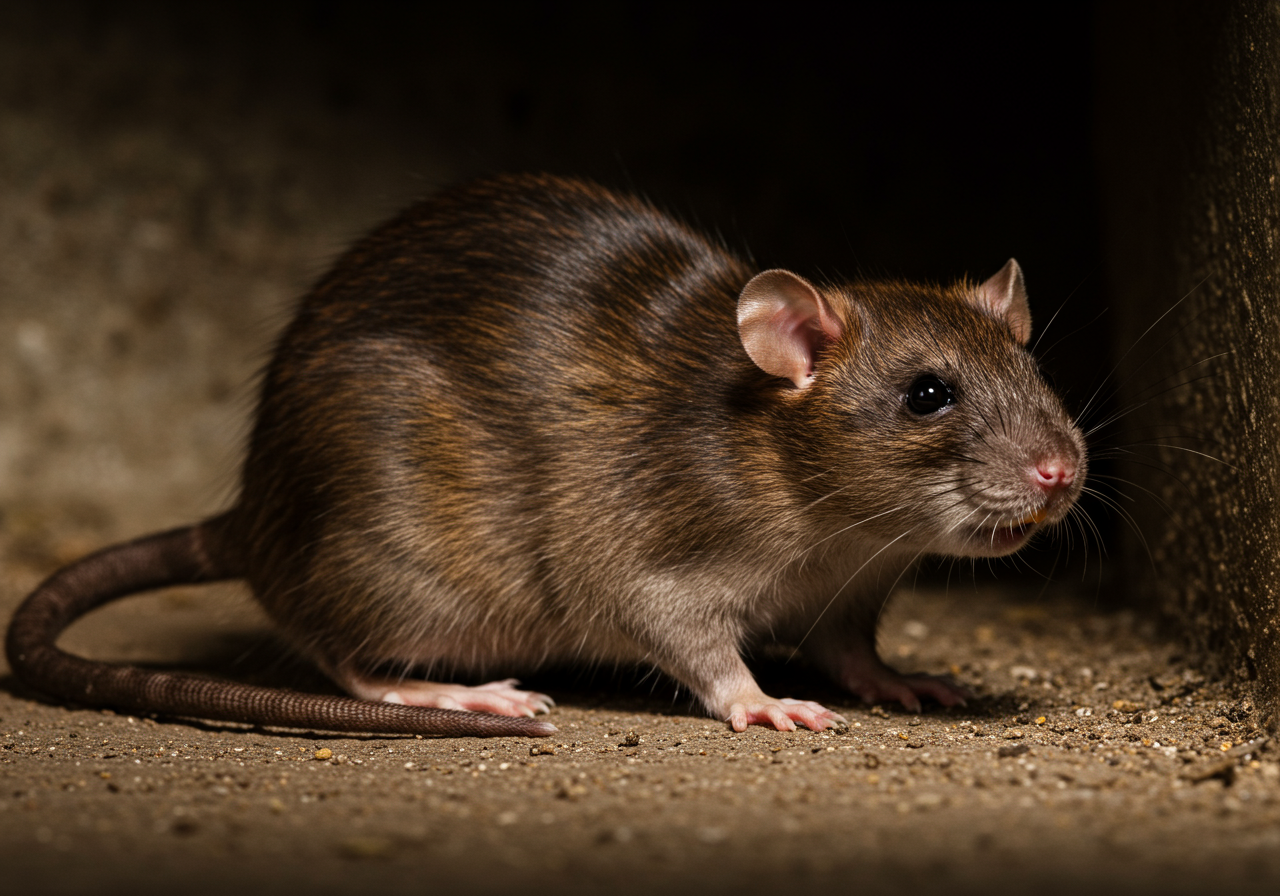
Norway rats are large and heavy-bodied, brown to gray, with a blunt nose, small ears, and a tail shorter than their body. They are burrowers and ground-dwellers. Indoors they nest low in the structure, in basements, crawlspaces, beneath slabs, and in wall voids near the foundation. Outdoors they dig burrows along foundations, under decks and sheds, in woodpiles, and in overgrown landscaping, and they readily travel sewer and drain lines. Because they live and move low, the activity you notice tends to be low too, scratching from the basement, burrows in the yard, gnawing near the foundation, which is exactly where the inspection and exclusion work concentrates.
Why DIY Rat Control Usually Fails
Rats are neophobic, meaning they are genuinely suspicious of anything new in their environment. Drop a couple of snap traps in a rat run and the rats will often avoid them for days, which is why store-bought efforts stall out. Store-bought bait carries its own problems too, both in how it is handled and in what it does after the rat dies, which we cover below.
The bigger issue is that trapping and baiting only address the rats currently inside. If the gaps that let them in stay open, a new group moves in on the same scent trails. Lasting rat control is a structural problem as much as a pest problem, and that is the part homeowners cannot easily see or reach.
Strategic Baiting Technology: Maximum Efficacy, Wildlife Conscious
When baiting is necessary to knock down an active population, we don't use old-school anticoagulants that linger in a rodent's system for days. Instead, we utilize an advanced, non-anticoagulant rodenticide featuring a naturally occurring compound that leverages the rat's own biology against it.
How It Works
The bait works by causing an overproduction of calcium in the rodent's bloodstream, a process called hypercalcemia. Once a rat consumes a lethal dose, its appetite drops off completely within 24 hours, stopping it from feeding further. The rodent quietly passes away shortly after.
Why It is Highly Effective
- No Bait Shyness: Traditional baits take days to work, which gives smart rats time to connect the bait with feeling sick and avoid it. This advanced formula works so efficiently that the colony doesn't develop that avoidance, leading to complete population knockdown in as little as 7 days.
- Saves Material and Time: Because rats stop feeding immediately after consuming a lethal dose, a single placement goes much further, accelerating the speed of the cleanup.
A Positive Impact on Local Wildlife and Pets
The biggest breakthrough with this specific formulation is its very low risk of secondary poisoning.
Here is the problem it solves. If a hawk, owl, fox, or family dog eats a rat that was poisoned by an old-school anticoagulant, that predator absorbs the toxin too, which can lead to illness or death. The toxin builds up the food chain and threatens the very predators that help keep rodent numbers down.
Our advanced bait breaks that cycle. The active compound does not accumulate and persist in the rat's tissue the way anticoagulants do, so if a bird of prey or neighborhood pet captures a treated rodent, the risk of secondary toxicity is extremely low. It allows us to solve heavy rodent pressure without endangering the local ecosystem, all while the bait stays secured in tamper-resistant stations placed out of reach of children and pets.
Our Rat Control Process
Step 1: Inspection and Identification
We inspect the full structure and the property around it, the foundation, basement, crawlspace, attic, utility penetrations, the roofline, and the yard. We map travel routes and nesting areas and locate every entry point a rat is using or could use. Rats can squeeze through a gap the size of a quarter, so this stage is detailed by necessity.
Step 2: Targeted Removal
Based on what the inspection finds, we deploy a control plan using tamper-resistant, secured stations and professional trapping placed precisely along active runs, never broadcast around your home. Everything is positioned in discreet, secure locations chosen to reach the population while keeping treatment inaccessible to children and pets.
Step 3: Exclusion and Prevention
This is the step that makes it last. We seal entry points using rodent-proof materials, steel mesh, hardware cloth, and appropriate sealants that rats cannot gnaw through, and we document larger structural gaps that need repair. We also walk you through the conducive conditions worth correcting, such as overgrown landscaping against the foundation, woodpiles, and unsecured garbage. We provide follow-up visits as needed to confirm the population is gone and the home stays sealed.
Signs You Have a Rat Problem
- Droppings up to three quarters of an inch long, dark and capsule-shaped, usually concentrated along walls or near food sources
- Gnaw marks on wood, wiring, pipes, or food packaging
- Scratching, gnawing, or heavy scurrying sounds inside walls, ceilings, or under floors, often at night
- Burrows in the yard near the foundation, woodpiles, or dense landscaping
- Smudge or rub marks along baseboards and beams from the oils in a rat's fur
- A persistent musky or ammonia-like odor in enclosed spaces
Any of these is worth a call. Rat populations do not resolve on their own, and the structural damage compounds the longer they stay.
Stop the Damage Before It Spreads
If you have seen a rat, found droppings, or are hearing activity in the walls or basement, the population is already established and growing. Fill out the form or call 973-309-7333 for a free quote.
Backed by our 100% satisfaction guarantee. If rat activity does not stop after treatment, we come back at no additional cost until the problem is fully resolved.
Rat Control Service Areas in North & Central Jersey
Inspect Pest Control provides professional rat removal throughout:
Essex County: Cedar Grove, Montclair, Verona, West Orange, Caldwell, North Caldwell, Livingston, Millburn, Maplewood, South Orange, Nutley, Belleville, Bloomfield, Glen Ridge, Fairfield, Roseland
Morris County: Parsippany, Florham Park, East Hanover, Morris Plains, Morristown, Madison, Chatham, Denville, Montville, Boonton, Whippany, Randolph
Passaic County: Wayne, Clifton, Little Falls, Totowa, Pompton Lakes, Ringwood
Union County: Summit, Westfield, Cranford, Springfield, New Providence, Watchung, Berkeley Heights, Scotch Plains, Mountainside
Bergen County: Ramsey, Allendale, Mahwah, Ridgewood, Ho-Ho-Kus, Waldwick, Wyckoff, Paramus, Hackensack, Teaneck, Glen Rock
What is the difference between a rat and a mouse problem? Beyond size, the big difference is behavior and difficulty. Rats are stronger gnawers that do more structural and wiring damage, they are more suspicious of traps, and they require larger entry points to be sealed. A mouse can fit through a dime-sized gap and a rat needs roughly a quarter-sized one, but rats are far harder to trap and exclude, which is why professional treatment matters more with rats.
Will poison alone get rid of my rats? Poison by itself is not a complete solution, and the type of poison matters. Old-school anticoagulant baits work slowly, can leave a rat to die inside a wall void, and pose real risks to pets, children, and the hawks and owls that hunt rodents. We take a different approach: a fast-acting, wildlife-conscious bait used inside secured, tamper-resistant stations, paired with sealing the entry points rats use. That combination removes the population and keeps it out, rather than just knocking it down temporarily.
How do rats get into a house? Rats enter through gaps around utility and pipe penetrations, foundation cracks, compromised vents and weep holes, and gaps under garage doors. Norway rats typically come in low, through the foundation, basement, and crawlspace, traveling along established routes. Finding and sealing these gaps is the core of lasting control.
Are your rat treatments safe for kids and pets? Yes. Control is placed in tamper-resistant stations and discreet, secured locations chosen specifically to reach rats while remaining inaccessible to children and pets. The exclusion work that seals entry points is what keeps rats out long term, and it is completely non-toxic.
How long does rat removal take? Most infestations show clear improvement within the first couple of weeks as trapping and control take effect, though the timeline depends on the size of the population and how the structure is built. The exclusion work is what prevents the next group from moving in, so we focus on sealing the home as part of the same job rather than treating repeatedly.
Get Your Free Rat Control Quote Today!
Are rats causing trouble in your NJ home? Don't let these pests take over! Fill out our easy form below. Inspect Pest Control's friendly team will quickly get in touch to understand your unique situation and provide a free, no-obligation quote for our effective and humane rat removal services. We're dedicated to helping local homeowners like you find lasting relief from rat infestations. Get started on a rat-free home today!
Behind the success stories
Read why customers choose us!

100% Satisfaction Guaranteed
We stand firmly behind the quality of our work with a 100% satisfaction guarantee. If you're not completely satisfied with our pest control service, we'll return to re-treat your home or business at no extra cost. If we still can’t resolve the issue to your satisfaction, we offer a full refund guarantee to ensure your peace of mind.

Family Owned and Operated
As a family-owned and operated business, we take great pride in our craftsmanship. We recognize the vital role of a clean and healthy home or business, and we're fully committed to providing top-notch pest management services.

4
reviews
170
reviews
55
reviews
8
reviewsGot an emergency?
Frequently Asked Questions
Frequently Asked Questions about our services
Beyond size, the big difference is behavior and difficulty. Rats are stronger gnawers that do more structural and wiring damage, they are more suspicious of traps, and they require larger entry points to be sealed. A mouse can fit through a dime-sized gap and a rat needs roughly a quarter-sized one, but rats are far harder to trap and exclude, which is why professional treatment matters more with rats.
Poison by itself is not a complete solution, and the type of poison matters. Old-school anticoagulant baits work slowly, can leave a rat to die inside a wall void, and pose real risks to pets, children, and the hawks and owls that hunt rodents. We take a different approach: a fast-acting, wildlife-conscious bait used inside secured, tamper-resistant stations, paired with sealing the entry points rats use. That combination removes the population and keeps it out, rather than just knocking it down temporarily.
Rats enter through gaps around utility and pipe penetrations, foundation cracks, compromised vents and weep holes, and gaps under garage doors. Norway rats typically come in low, through the foundation, basement, and crawlspace, traveling along established routes. Finding and sealing these gaps is the core of lasting control.
Yes. Bait is placed in tamper-resistant stations and discreet, secured locations chosen specifically to reach rats while remaining inaccessible to children and pets. The exclusion work that seals entry points is what keeps rats out long term, and it is completely non-toxic.
Other services
Some other service you might be interested in